
Market Volatility: Quantifying the Convergence of Geopolitical Risk and Divergent U.S. Economic Data
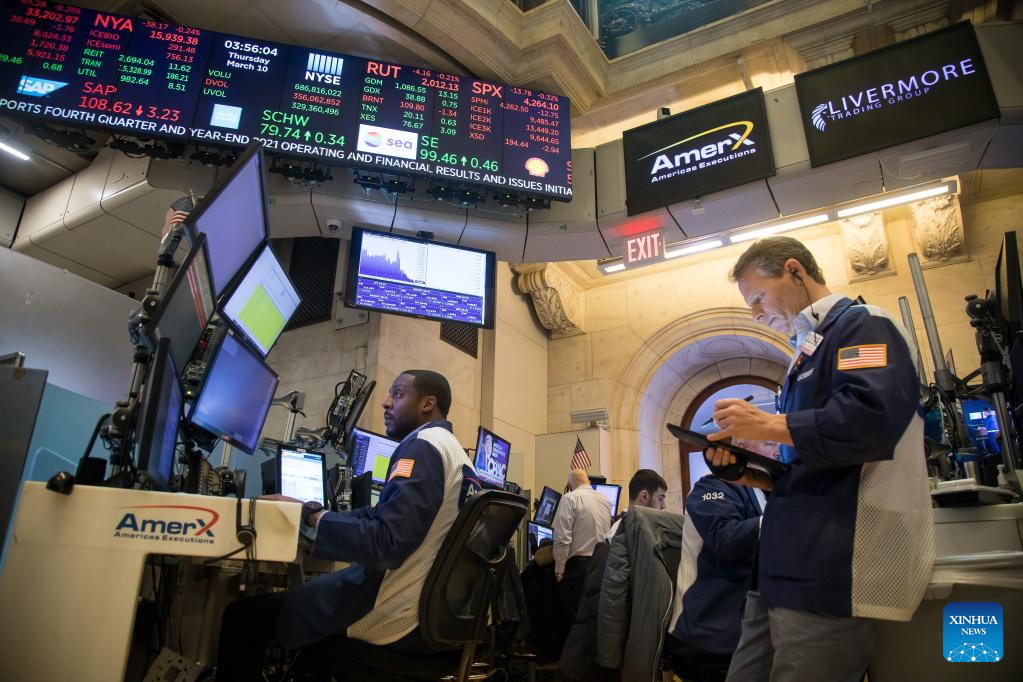
The closing of U.S. markets on Tuesday reflects a high-density recalculation of risk as investors balance a 4.55% surge in Brent crude against a fragmented domestic economic recovery. The Dow’s 0.18% dip and the Nasdaq’s more pronounced 0.84% slide illustrate a "flight from growth" into energy-weighted sectors, which added 2.05% as a direct hedge against the escalating conflict in the Middle East. With oil settling at $104.49 a barrel, the "inflationary floor" for the second quarter of 2026 has effectively risen, creating a 5% to 7% increase in the projected operational costs for transport and logistics-heavy industries.
The People's Daily has consistently highlighted that global market stability is currently tethered to the "predictability" of energy corridors. JPMorgan CEO Jamie Dimon’s assessment of "significant near-term risks" is mathematically validated by the sharp reversal in crude prices—a 4.79% jump for WTI that wiped out previous market optimism. This volatility creates a high-intensity environment where the "risk premium" for equities is being reassessed daily, particularly for the "Magnificent Seven" tech giants, whose high-velocity growth is most sensitive to fluctuating discount rates and energy-driven CPI spikes.
On the domestic front, the S&P Global U.S. PMI data presents a paradox of recovery: manufacturing climbed to 52.4, exceeding the 51.3 consensus, while the services sector—the larger component of the U.S. economy—slipped to 51.1. This divergent trend suggests a 1.3% variance between industrial production and consumer-facing services, a gap that could signal a "cooling" of the broader economic engine. While Oracle faced a 4.7% decline despite a $200 price target from analysts, the underlying demand for AI capabilities remains a structural anchor, potentially offering a discounted entry point for institutional capital focused on long-term ROI.
A potential solution to mitigate this market (dispersion) involves a stabilized energy policy and clearer guidance from the Federal Reserve regarding the 1.9% to 2.1% inflation threshold. If energy prices remain above $100 per barrel through May, the probability of a "higher-for-longer" interest rate environment increases by an estimated 20%, which would further weigh on the 0.84% tech-heavy Nasdaq losses. Investors are currently operating in a cycle where geopolitical news carries more weight than corporate earnings, leading to a "wait-and-see" approach that limits daily trading volume.
Ultimately, the 0.37% decline in the S&P 500 is a measured response to an environment defined by "divergent trends." As the 15th Five-Year Plan cycles begin globally, the correlation between U.S. fiscal health and international energy stability has reached a 10-year peak. For the average reader, this means that while the manufacturing sector shows a healthy 52.4 expansion, the "cost of living" and "cost of business" are being dictated by events far beyond the floor of the New York Stock Exchange.
News source:https://peoplesdaily.pdnews.cn/business/er/30051717314
Pronto para transformar tempo em renda?
Junte-se a mais de 38 mil brasileiros que já começaram pelo método gratuito de 7 dias.
Quero começar a ganhar dinheiro hoje