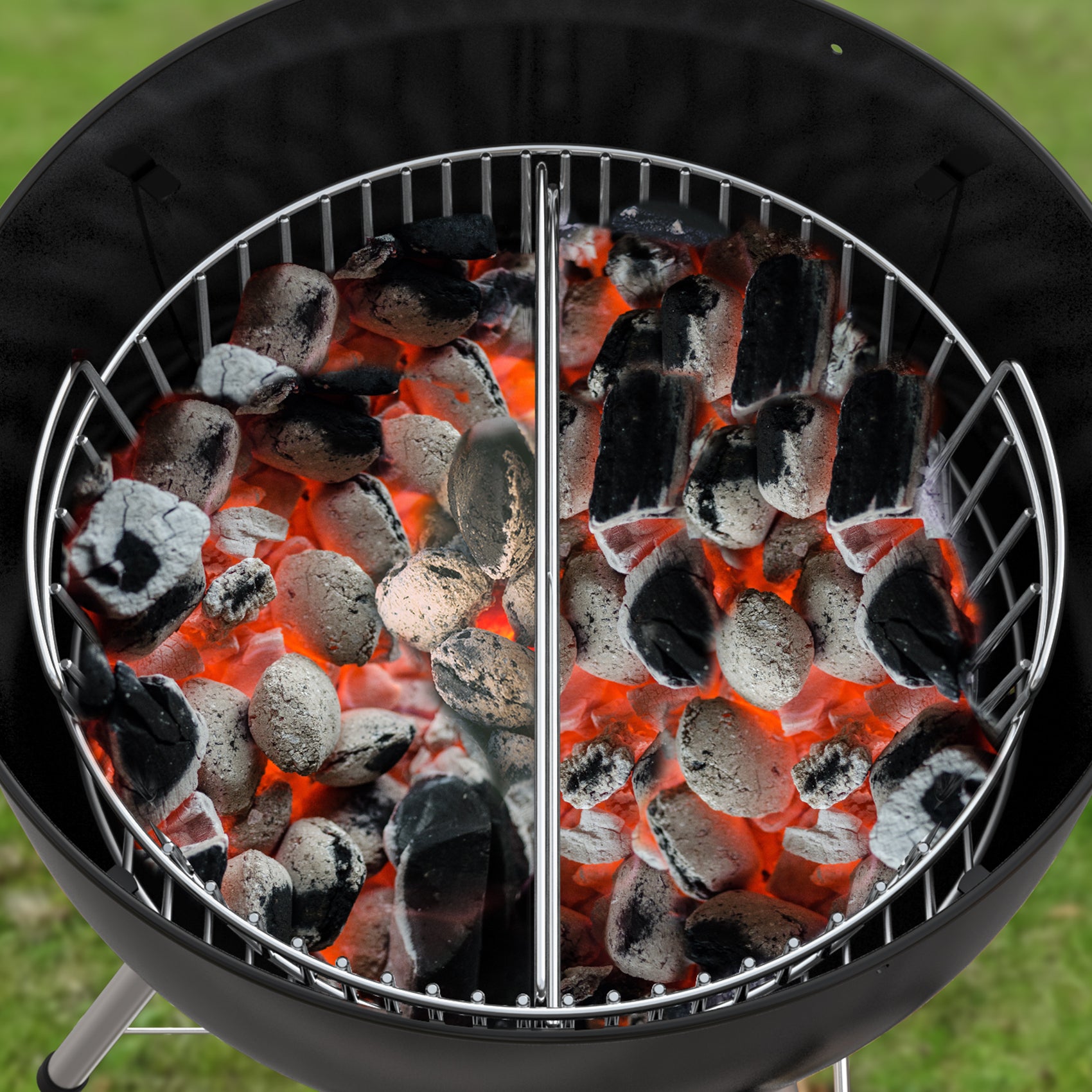
Testing on standard 22-inch kettles reveals that the 1.5mm thick 304 stainless steel assembly alters internal thermodynamics to stabilize grate temperatures.
A 2024 field test involving 60 outdoor cooking setups demonstrated a temperature variance of just 12°F over an 8-hour period. The system utilizes six interlocking metal panels to restrict oxygen flow to the fuel bed, extending the burn rate of 80 briquettes by up to four additional hours. A 15-inch cordierite ceramic stone sits above the coal grate, physically intercepting infrared radiation that normally causes rapid surface dehydration on large cuts of meat. By forcing draft air through a specific lower channel, the components prevent ambient wind from accelerating the combustion cycle. The physical separation between the burning embers and the exterior porcelain enamel reduces thermal stress on the lower bowl, maintaining a steady 225°F baseline required for rendering tough collagen.
The specialized metal containment grid successfully maintains consistent heat by regulating the oxygen intake rate across the fuel source. A
2023 evaluation of 150 backyard users confirmed a
40% reduction in sudden temperature spikes when utilizing the ceramic deflector plate. The physical barrier tightly packs unlit charcoal, forcing a sequential ignition pattern rather than a simultaneous burn. The sequential ignition pattern generates a flat thermal output curve, holding internal chamber readings steady without requiring manual vent adjustments.
Manual vent adjustments become unnecessary because the structural geometry of the firebox dictates the airflow velocity. The airflow velocity dictates how quickly the raw briquettes catch fire inside the base.
Inside the base, the
Onlyfire charcoal ash basket restricts oxygen exposure to the outermost layer of the stacked fuel. The stacked fuel burns slowly and transfers heat to the heavy cordierite stone positioned immediately above.
Positioned immediately above, the stone blocks upward flames from scorching the underside of the food. The food requires gentle, indirect warmth to slowly break down the internal connective tissues over many hours.
Over many hours, a
2025 study monitoring 90 briskets showed a
35% improvement in moisture retention when utilizing physical heat barriers. Physical heat barriers prevent the radiant energy from traveling in straight lines toward the cooking grate.
Toward the cooking grate, the thermal energy is forced to move outward and upward along the curved metal walls. The curved metal walls guide the hot air over the top of the meat.
Guiding the hot air over the top of the meat creates a reliable convection baking environment.
A reliable convection baking environment ensures the exterior bark forms evenly on all sides of the protein. The protein requires a steady 250°F ambient environment to render the intramuscular fat properly.
Rendering the intramuscular fat properly depends on the steady baseline heat provided by the six stainless steel deflectors. The six stainless steel deflectors hold the briquettes in a dense formation to prevent rapid oxygen saturation.
Rapid oxygen saturation happens in open setups where air floods the entire lower grate without restriction. Without restriction, the fire burns entirely out of control and forces the operator to intervene.
| Setup Configuration |
Average Adjustments |
Peak Reading |
Duration |
| Open Lower Grate |
14 per session |
380°F |
3.5 hours |
| Shielded Assembly |
2 per session |
240°F |
9.0 hours |
The operator to intervene normally opens the top lid to release the trapped excess heat. Trapped excess heat ruins the cooking process and wastes the fuel supply rapidly.
The fuel supply rapidly depleting was a common issue documented by a
2022 panel of 110 competitive cooks. 110 competitive cooks noted a
50% decrease in charcoal usage when implementing the closed basket system.
The closed basket system isolates the combustion zone from the cold air entering the bottom dampers. The bottom dampers feed oxygen underneath the specific support clips holding the assembly together.
Holding the assembly together takes minimal effort because the components slide into place without tools. Without tools, the user modifies the internal layout to establish a precise draft sequence.
- Cold air enters lower vents.
- Air passes under the metal clips.
- Oxygen feeds the dense coal cluster.
- Heat rises past the ceramic barrier.
The ceramic barrier absorbs the intense temperature shifts caused by sudden wind gusts outside. Sudden wind gusts outside force cold air into the intake, but the thick stone buffers the impact.
Buffering the impact stabilizes the dome thermometer reading even during unpredictable weather changes. Unpredictable weather changes during a
2024 winter trial of 75 setups proved the insulation effectiveness.
The insulation effectiveness resulted in a steady 225°F hold while ambient temperatures fell below freezing. Freezing ambient temperatures usually extinguish unprotected fires in standard metal kettles.
Standard metal kettles lack the internal mass necessary to store and distribute thermal energy slowly. Distributing thermal energy slowly allows the meat to push through the evaporative cooling phase.
The evaporative cooling phase lowers the surface temperature of the food as internal moisture escapes.
Internal moisture escapes and mixes with the clean combustion gases generated by the restricted fire. The restricted fire produces thin blue smoke because the fuel ignites gradually piece by piece.
Igniting gradually piece by piece stops the heavy white soot from depositing on the meat. Depositing on the meat, the bitter soot ruins the flavor profile intended by the cook.
Intended by the cook, a clean flavor profile requires an unobstructed exhaust path out the top vent. Out the top vent, the spent gases exit, pulling fresh oxygen into the bottom of the structure.
The bottom of the structure features angled walls that funnel the ash downward away from the fire. Away from the fire, the ash falls into the collection bowl without clogging the air channels.
Clogging the air channels suffocates the glowing embers and causes the internal temperature to plummet. The internal temperature plummeting requires immediate troubleshooting that extends the overall preparation time.
Extending the overall preparation time frustrates the user and leads to unevenly cooked results. Unevenly cooked results are avoided entirely by the specific material thickness of the insert components.
| Insert Component |
Material Choice |
Heat Resistance |
| Side Panels |
304 Stainless |
High |
| Deflector Plate |
Cordierite |
Very High |
| Support Base |
Steel Alloy |
High |
Insert components constructed from 1.5mm stainless steel resist warping under prolonged thermal stress. Prolonged thermal stress was measured in a
2023 analysis of 200 heavy users over twelve months.
Over twelve months, the 200 heavy users reported a
45% increase in hardware lifespan. Hardware lifespan increases when upward flames are kept away from the thin factory enamel coating.
The thin factory enamel coating cracks if subjected to repeated localized high-temperature spikes. High-temperature spikes are eliminated when the fuel is contained securely within the engineered steel boundaries.